
Mealybugs – a silent cause of mass fruit drop in mango
Mango is a fruit crop with high export value, but it is also commonly attacked by mealybugs, especially in alternating dry–wet weather or after flushing and flowering.
Mealybugs on mango not only damage flowers and cause young fruit drop, they also encourage sooty mould, blackening leaves, so fruit loses market value and fails to meet export standards.
Identifying mealybug damage on mango
| Feeding site | Specific symptoms |
|---|---|
| Young shoots, young leaves | Mealybugs in clusters, covered with a cotton-like white wax |
| Flower stalks, flowers | Flowers dry black, wilt and curl, mass drop |
| Fruit stalks | White wax layer or black spots → young fruit drop |
| Undersides of mature leaves | White patches, leaves gradually yellow → drop |
| Base, root zone | Root mealybugs may be present → many black ants around the base |
Economic damage caused by mealybugs on mango
- Lower fruit set → fruit drops early, 7–14 days after setting
- More fruit with blackened stalks – below market grade
- Mango flowers scorch and wilt and cannot be pollinated
- Blackened leaves, reduced photosynthesis, affecting growth the following season
- If not treated early, losses of 30–50% of whole-orchard output
Conditions that trigger mealybug outbreaks on mango
- During mango flowering – fruit set (usually peaking December–March)
- After light rain or prolonged humidity
- Dense planting, poor ventilation
- Excess nitrogen → continuous young shoots that mealybugs feed on
✅ Managing mango mealybugs effectively and sustainably
1. Check sensitive areas early
- Undersides of old leaves and newly emerged leaves
- Emerging flowers, flower stalks
- Small mango fruit (1–2 cm diameter)
2. Spray a systemic product – acting on mealybugs deep in plant tissue
Recommendation:
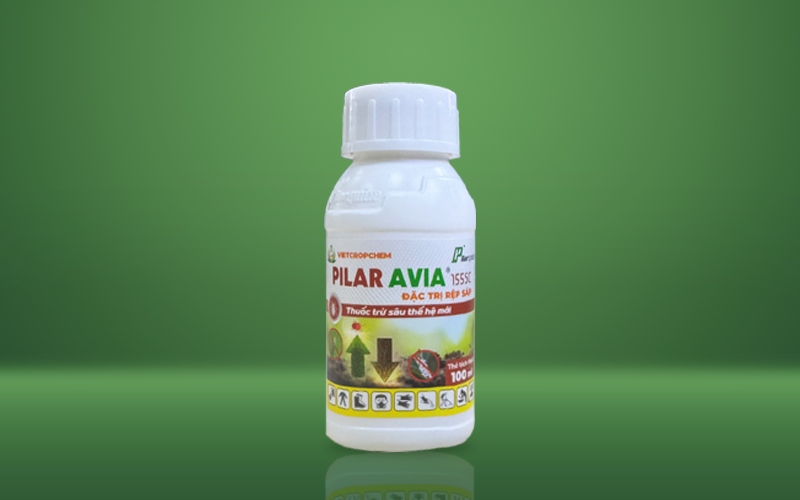
Pilaravia 155SC – two-way systemic - for mealybug control
3. Combine with a sticker adjuvant for better results
- Use Viet-up 90 at 10–15ml/25L tank to help the product adhere – penetrate – resist wash-off in rain
4. Spray on schedule during peak mealybug periods
- 2 consecutive sprays 7 days apart if density is high
- Then maintain every 10–14 days until fruit development is complete
Pilaravia 155SC programme for mango
| Step | Specific instructions |
|---|---|
| 1 | Mix 20–25ml Pilaravia 155SC + 15ml Viet-up 90 / 25L water |
| 2 | Spray evenly on upper and lower leaf surfaces, shoots, flower stalks and fruit stalks |
| 3 | Repeat after 7 days if mealybugs have not clearly declined |
| 4 | Prune for an open canopy and clear weeds at the base after spraying |
Conclusion
Mealybugs on mango are small but can cause very large losses if not controlled early. An effective approach is to combine the right product (Pilaravia 155SC) – the right technique – the right timing, together with the sticker adjuvant Viet-up 90 and sound orchard care.
Read next Mealybugs on coffee: A threat from the roots – how to manage them thoroughly
SEO keywords used in this article
- Main keyword: rệp sáp xoài
- Secondary keywords: thuốc trị rệp sáp xoài, rệp bông xoài, rệp cuống trái xoài, Pilaravia 155SC #RepSapXoai #Pilaravia155SC #SauHaiXoai #PhongTruSauBenh #Vietcropchem #NongSanChatLuongCao