
Mealybugs not dying despite repeated spraying?
Many growers spray all kinds of products, but mealybugs remain "as hard as stone", and may even spread faster after each treatment. The cause is not the product itself, but mostly an incorrect treatment procedure that does not match the biology of mealybugs.
Here are 5 common mistakes that make mealybug treatment ineffective, with corrective measures according to Vietcropchem specialists' recommendations.
1. Spraying broad-spectrum products not targeted at mealybugs
Many people use general insecticides or combine too many unsuitable active ingredients → resulting in low efficacy, with mealybugs not dying or not fully controlled.
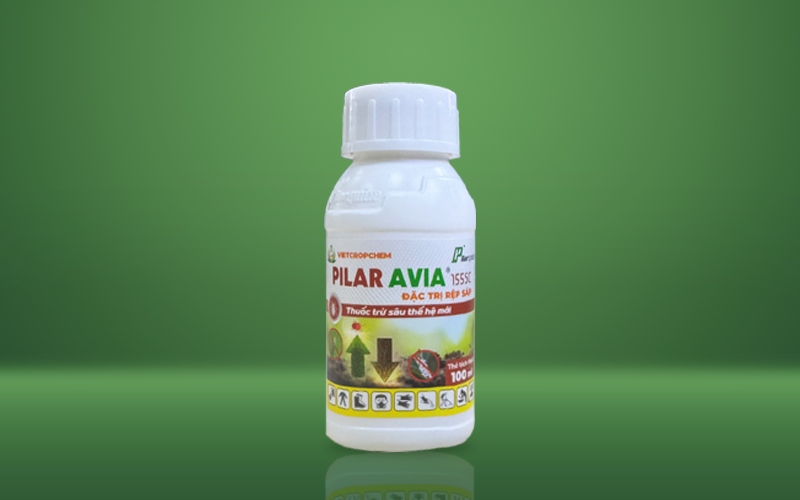
✅ Solution: Choose a product targeted at mealybugs, with deep systemic and tissue-penetrating action, such as Pilaravia 155SC – helping the active ingredient move through the plant's vascular system and reach mealybugs in roots, stems and leaf sheaths.
2. Ignoring the roots and base – where mealybugs hide most
Most mealybugs live not only on stems and leaves but deep at the base, root collar and in the soil. Spraying only the canopy misses the main colonies, so the problem recurs quickly.
✅ Solution: When spraying, focus thoroughly on the tree base, the soil around the roots and the lower stem, and consider drenching the base with a diluted product if mealybugs are found on the roots.
3. Not adding a sticker adjuvant – the product washes off, efficacy drops
Mealybugs have a thick wax coating, so many products slide off the surface or do not penetrate the mealybug's body.
✅ Solution: Combine a sticker – penetrant such as Viet-up 90 to help the product adhere better to the wax layer and penetrate plant tissue, increasing mealybug control efficacy by up to 30–40%.
4. Spraying at the wrong point in the mealybug life cycle
Spraying when mealybugs are adults, move slowly and already have a thick wax layer → low efficacy. The most sensitive stage is newly hatched nymphs (crawlers) – their bodies are still soft and easier to control.
✅ Solution: Spray on schedule every 10–14 days, especially after rain or when plants are flushing, to target the crawler stage.
5. Spraying and leaving it – no checks or follow-up after treatment
Many people do not check 3–5 days after spraying, missing signs of recurrence or noticing too late.
✅ Solution: After each treatment, check the base, leaf sheaths and leaf undersides carefully to assess results. If numbers have not clearly declined, re-spray with the correct technique – do not overdose.
Mealybug treatment procedure recommended by Vietcropchem
- Spray Pilaravia 155SC at 20–25ml + Viet-up 90 20ml/25L tank
- Spray evenly to wet leaves, stems, base and the soil in the root zone
- Re-check after 3–5 days; if mealybugs are not all dead → treat a 2nd time
- Routine prevention every 14–21 days in the rainy season or when plants flush
Conclusion
Mealybug control does not depend only on the product, but also on using the right technique, at the right time, in the right combination. Avoiding these 5 common mistakes is key to helping growers save costs and protect the crop more effectively.
Read next: https://vietcropchem.com/tin_tuc/Phoi-hop-thuoc-va-phu-gia-nhu-the-nao-de-diet-rep-sap-hieu-qua-hon Pilaravia 155SC product information: https://vietcropchem.com/san_pham/PILARAVIA-155SC
SEO keywords in this article:
sai lầm khi trị rệp sáp, rệp sáp không chết, trị rệp không hiệu quả, phun thuốc không hết rệp, rệp sáp tái phát
#Pilaravia155SC #ThuocTriRepSap #LuuDan2Chieu #RepSapCayTrong #ThuocTruSauLuuDan #Vietcropchem #repsap #chichhut #ray
#RepSap #PhongTruRepSap #SauHaiCayTrong #PhongTruSauBenh #NongNghiepThongMinh #BenhRepSap #TruRepHieuQua #RepSapSauRieng #RepSapXoai #RepSapCaPhe #RepSapHoTieu #RepSapThanhLong #RepSapChomChom #RepSapNhan #RepSapMit #Pilaravia155SC #ThuocTriRepSap #ThuocLuuDan2Chieu #ThuocTruRep #GiaiPhapChoNhaNong #VuMuaBoCach #NongSanChatLuong #Vietcropchem