Spraying again and again but the disease keeps coming back? You may be treating it the wrong way
Anthracnose is one of the most common fungal diseases in agriculture and can cause serious losses. In practice, however, many growers spray repeatedly but the disease does not go away, and may even spread faster after each rain.
The cause is not only the product; it often comes from incorrect treatment procedures or a misunderstanding of the disease.
Here are 5 common mistakes that make anthracnose keep recurring
1. Spraying too late – only treating once the disease has broken out
Many growers start treating only when lesions are already deep on leaves, fruit or stems. By then the fungus has entered the vascular tissue and spread.
✅ Solution: Prevention first – treatment second. Spray on a schedule before flushing, before flowering or after prolonged rain to control the disease early.
2. Using contact products – with no systemic action
Contact products work only on the leaf/fruit surface. Colletotrichum spp. often develops deep in tissue, especially fruit stalks, flower stalks and leaf veins.
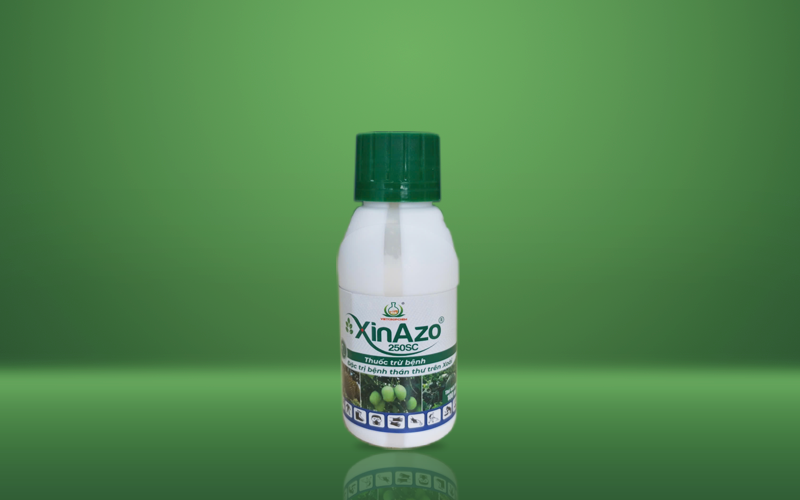
✅ Solution: Prefer systemic fungicides such as Xinazo 250SC, which help the active ingredient penetrate and move through the whole plant, acting on the fungus even after it has entered internal tissue.
3. Not rotating active ingredients – building resistance
Using one product or one active ingredient continuously over several seasons lets the fungus develop resistance, so the product gradually loses effectiveness.
✅ Solution: Rotate products from different active ingredient groups. Xinazo 250SC contains a Strobilurin-group active ingredient and can be combined with groups such as copper, mancozeb...
4. Uneven spraying, incorrect technique
- Uneven spraying that misses leaf undersides and flower stalks → disease remains and flares up after rain.
- Low-pressure sprayers → the product does not penetrate tissue and stays on the leaf surface.
✅ Solution: Use a sprayer with good pressure, spray evenly to wet both leaf surfaces – young shoots – flower stalks – fruit, and add a sticker adjuvant when spraying in humid or dewy conditions or when rain is likely.
5. Not combining with orchard hygiene and disease residue management
Many people only spray but do not collect infected branches and leaves, do not remove lesioned fruit, and do not treat the tree base → fungal spores persist and spread again after every rain.
✅ Solution: Clean the orchard after each season, collect and destroy sources of disease, prune for an open canopy and improve drainage in the rainy season.
In short: anthracnose can be managed – what matters is treating it correctly
| Mistake | Fix |
|---|---|
| Spraying late | Early, scheduled prevention |
| Non-systemic product | Use Xinazo 250SC – systemic |
| Using one active ingredient forever | Rotate product groups |
| Careless spraying, poor technique | Spray correctly – adequately – evenly – thoroughly |
| No orchard hygiene | Collect residue, remove diseased shoots |
✅Suggested product for anthracnose
Xinazo 250SC – a broad-spectrum fungicide used against anthracnose, with these features:
- Systemic – penetrates through the whole plant
- Broad spectrum – acts on many fungi
- Performs well in humid/rainy conditions
- Suitable for many crops: mango, durian, coffee, chilli, rambutan…
Product details: https://vietcropchem.com/san_pham/XinAzo-250SC
Read next [Article 5]:
Xinazo 250SC – A solution for anthracnose and broad-spectrum fungal diseases
SEO keywords used in this article
- Main keyword: sai lầm khi trị bệnh thán thư
- Secondary keywords: trị bệnh không hiệu quả, bệnh tái phát, vì sao thán thư không hết, thuốc lưu dẫn, phun không đều #ThanThu #TriBenhKhongHieuQua #BenhTaiPhat #Xinazo250SC #Vietcropchem