
Mealybugs – a silent cause of blemished fruit that fails both market and export standards
Mealybugs on rambutan, longan and jackfruit are common in the rainy season and from young to maturing fruit. They hide at fruit stalks, flower clusters, between spines (jackfruit) and on leaf undersides, sucking sap and excreting honeydew that encourages sooty mould.
As a result, fruit loses its bright colour, the skin turns dull – with black spots – lighter weight – early drop, traders refuse to buy, and growers suffer heavy losses.
Signs of mealybugs on each crop
| Crop | Specific symptoms |
|---|---|
| Rambutan | White spots around the fruit stalk, rough fruit, stunted spines, young fruit drop |
| Longan | White cottony mealybugs on flower clusters, dry flowers, poor fruit set |
| Jackfruit | Mealybugs between spines and on fruit stalks → fruit does not grow, cracks, has lesions |
Note: Mealybugs on these 3 crops are often accompanied by black ants → inspect carefully in the early morning at stalks, leaf bases, young stems and small fruit.
Economic damage caused by mealybugs
- Reduced fruit set due to dried flowers and spreading sooty mould
- Rough, misshapen fruit, market value reduced by 30–50%
- Higher young fruit drop, especially after rain or mistimed fertilising
- Mealybugs multiply fast and spread across the orchard → continuous spraying needed if not controlled early
When do mealybugs thrive?
- Rainy season (April–October) – high humidity, continuous fruiting
- During flowering, young fruit set and fruit development
- Dense orchards, excess nitrogen, overly close planting – poor ventilation
Managing mealybugs in the rainy season – effectively and gently on the fruit
1. Inspect at the right time and place
- Inspect in the early morning or cool afternoon
- Check fruit stalks, flower clusters, between spines, leaf undersides and lower stems
2. Use a systemic product – acting on mealybugs from within plant tissue
Recommendation:
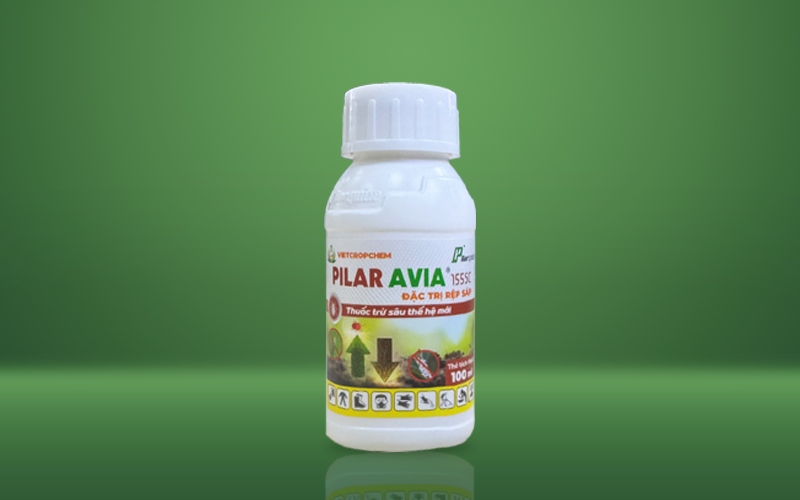
Pilaravia 155SC – two-way systemic – for mealybug control: https://vietcropchem.com/san_pham/PILARAVIA-155SC
3. Combine with Viet-up 90 to improve results in heavy rain
- Improves adhesion – reduces wash-off in rain
- Improves spreading on waxy surfaces or jackfruit spines
4. Spray on schedule – break the mealybug breeding cycle
- Round 1: on detection → treat early
- Round 2: after 7 days → target young mealybugs not affected the first time
- After that: every 14–20 days if conditions remain humid
Pilaravia 155SC programme for rambutan – longan – jackfruit
| Purpose | Specific instructions |
|---|---|
| Prevention | 15ml Pilaravia + 10ml Viet-up 90 / 25L – spray evenly to wet |
| Treatment when mealybugs appear | 25ml Pilaravia + 15ml Viet-up 90 / 25L – spray thoroughly on stalks – fruit – base |
| Check results | 3–5 days after spraying → mealybugs dry out and fall off fruit/leaves |
Conclusion
Mealybugs on rambutan, longan and jackfruit are hard to detect but seriously damage fruit appearance – weight – price. Controlling them from the start of the season with a systemic product such as Pilaravia 155SC, together with Viet-up 90 and sound orchard practices, is an effective, economical and sustainable approach.
Content series overview:
You can also read:
- What are mealybugs? Characteristics, life cycle and risks to crops in Vietnam
- Mealybugs on durian: Detect early to avoid crop loss
- Mass fruit drop in mango? Don't ignore signs of mealybug attack
- Pepper yellowing and dying fast – mealybugs are a main cause
SEO keywords used in this article
- Main keywords: rệp sáp chôm chôm, rệp sáp nhãn, rệp sáp mít
- Secondary keywords: rệp sáp mùa mưa, thuốc trị rệp sáp trái cây, Pilaravia 155SC #RepSapChomChom #RepSapNhan #RepSapMit #Pilaravia155SC #NongSanSạch #Vietcropchem