Mealybugs – a "silent killer" in Central Highlands coffee farms
Mealybugs on coffee usually appear at the base, root collar, leaf undersides and young stems. Small, hard to detect and usually hiding in damp conditions, mealybugs quietly suck sap, causing yellow leaves, dry branches and poor fruit set, and more seriously plant death if not managed in time.
In practice, mealybugs are a major cause of yield loss and decline in old coffee farms in Đắk Lắk, Gia Lai, Lâm Đồng and other Central Highlands areas.
Signs of mealybugs on coffee
| Feeding site | Specific symptoms |
|---|---|
| Root collar – base | Spongy cotton-like white patches, many black ants |
| Young stems – branch bases | Bark slightly swollen, brown sap oozing, gradually drying |
| Leaf undersides | Leaves gradually yellow, drop early, sometimes a white wax layer |
| Young fruit | Does not grow, uneven, shrivelled fruit |
Damage caused by mealybugs on coffee
- Yellow leaves, weakened plants, poor fruit set
- Yield reduced by 20–40% if mealybugs appear during fruiting
- Root rot, branch dieback, dry berries in old coffee farms
- Infested plants are more prone to nematodes, root rot and bacterial wilt
- If not managed thoroughly → mealybugs spread quickly to neighbouring farms
When do mealybugs thrive?
- Start of the rainy season (April–June): moist soil, dense weeds at the base, new flushes
- Farms with excess nitrogen and little pruning → many shoots, mealybugs multiply fast
- In old coffee farms with weak roots and no early prevention
✅ Managing coffee mealybugs effectively from the base
1. Check the base and root collar early
- Dig lightly around the base and check the moist soil layer
- Inspect the bark at the base and the area at ground level
- If black ants are climbing the stem → mealybugs are very likely present
2. Use a two-way systemic product that acts from the inside
Recommendation:
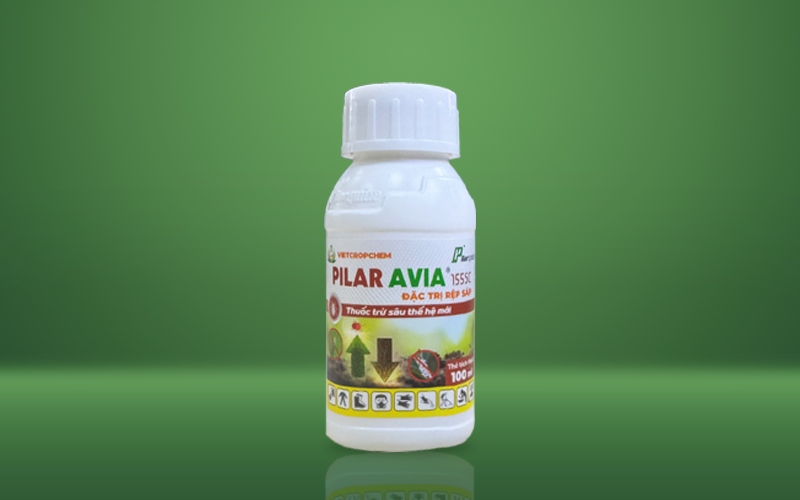
Pilaravia 155SC – two-way systemic - for mealybug control
3. Combine with the sticker adjuvant Viet-up 90
- Helps the product adhere into plant tissue – less wash-off
- Useful when spraying in the rainy season or on red basalt soil
4. Spray evenly + drench the base where mealybugs are concentrated
- Dilute the product to drench the root/collar zone if mealybug density is high
How to use Pilaravia 155SC on coffee
| Purpose | Instructions |
|---|---|
| Prevention | Mix 15–20ml/25L tank, spray every 14 days |
| Treatment on detection | Mix 25ml Pilaravia + 15ml Viet-up 90 / 25L tank |
| Base drench | Dilute 10ml/10L water – drench around the base |
| Repeat | After 7 days if mealybugs have not clearly declined |
Conclusion
Mealybugs on coffee are a serious pest, hard to detect early and easily spread through soil, roots and ants. An effective approach is to combine careful inspection – a two-way systemic product (Pilaravia 155SC) – a supporting adjuvant (Viet-up 90), together with base hygiene – black ant control to protect coffee farms over the long term.
Read next: Pepper yellowing and dying fast – mealybugs are a main cause
SEO keywords used in this article
- Main keyword: rệp sáp cà phê
- Secondary keywords: thuốc trị rệp sáp gốc cà phê, rệp hại rễ cà phê, Pilaravia 155SC, thuốc trừ rệp mùa mưa #RepSapCaPhe #Pilaravia155SC #ThuocTriRep #CaPheTayNguyen #Vietcropchem #PhongTruSauBenh